

Echoes Across Time: What If You Could Sit Down with History’s Greatest Minds and Ask the One Question That Keeps You Up at Night?
What if you could travel back in time — not with a machine, but through the quiet power of lucid dreaming — and have a real conversation with any figure from the past? Would you discuss free will and destiny with them? Who would you choose? What single question would you ask?
For me, the answer was immediate.
I’ve always believed fiercely in free will — the idea that we shape our own lives through choice, effort, and moral courage. Yet my own story is riddled with events I can only describe as destiny: the execution of my father by the Castro regime when I was eight, our desperate flight from Cuba, the improbable path that turned a frightened boy into an American citizen with a loving family and a life I never could have planned.
Free will and destiny. They feel like opposites, yet both feel true. That tension — that unexplained, misunderstood dichotomy — became the obsession that launched Echoes Across Time: Time-Travel Dialogues.https://amzn.to/4e6yttB
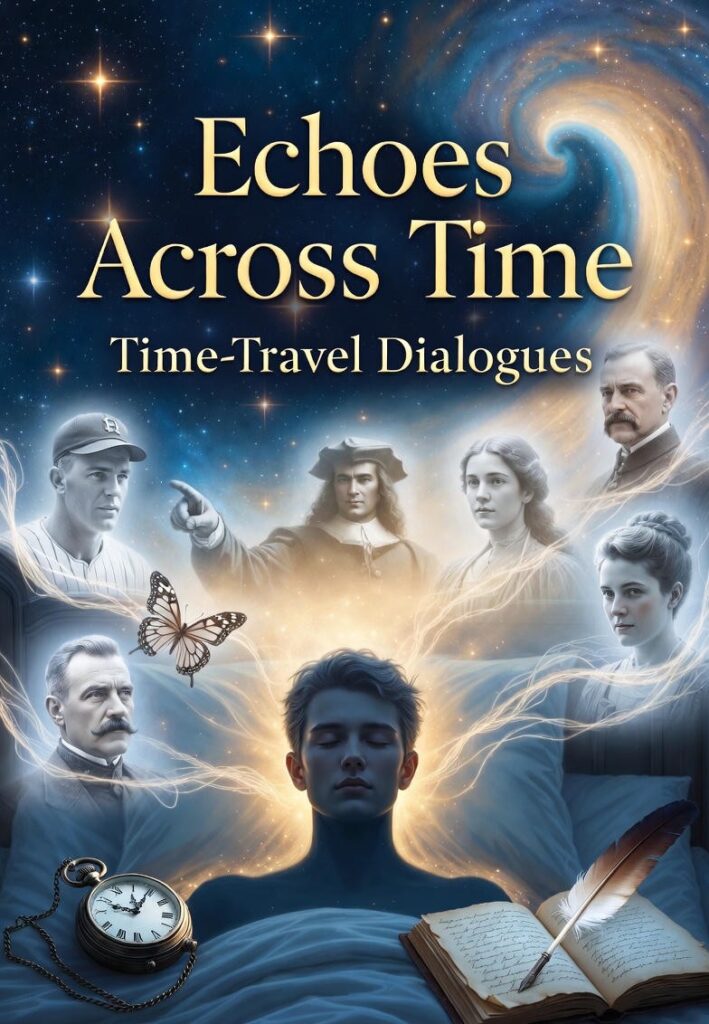
In the book, I use lucid dreaming as my time machine. I visit the heroes, thinkers, leaders, and visionaries who have haunted my imagination, and I ask them the same burning question: How do you reconcile free will and destiny?
Here’s what I learned—and why these conversations changed everything.
Mickey Mantle: The Demotion That Was Destiny in Disguise
October 1964. Yankee Stadium locker room. The Mick is still in his #7 uniform, cigar glowing, celebrating a World Series-clinching homer.
I asked him about 1951 — the year the Yankees sent the 19-year-old phenom down to the minors. He called it the lowest moment of his life. Then his father drove from Oklahoma, shamed him into staying, and something shifted.
Mantle’s answer: “That demotion? The best thing that ever happened to me. Taught me I could take a punch and get back up. Without Kansas City, there’s no Triple Crown, no 536 homers, no seven rings.”
He saw destiny not as a gentle path but as the very obstacles that forged him. Free will was the stubborn decision to unpack his bags and swing the bat again.
General George S. Patton: “I’ve Died a Hundred Times Before”
December 1944. Verdun, France. The Ardennes Offensive. Patton walks into Eisenhower’s war room with three pre-written plans to relieve Bastogne.
He believed he had fought at Troy, in the Roman legions, at Waterloo. Reincarnation wasn’t a theory — it was a lived memory.
Patton’s answer: “Destiny had already written the final chapter. Fear was irrelevant; only duty remained.”
Yet he also said, “Drive on, son. Always drive on.” Free will was the refusal to quit when every sane voice said stop. Destiny was the river; free will was the rudder.
William Butler Yeats: Gyres, Masks, and the Flame Inside the Machine
June 1922. Thoor Ballylee, Ireland. Yeats welcomed me into his tower and spoke of interlocking gyres — vast cosmic cones that spin history and the lives of individuals.
Yeats’s answer: Destiny sketches the broad arcs, and the moon’s phases shape our inclinations, but free will is the flame that dances within the gyre. “The mask is offered, but how we wear it — with grace, distortion, or transcendence — that is the soul’s free act.”
Abraham Lincoln: The River and the Rudder
March 1865. Washington, D.C. Rain on the Capitol steps after his second inaugural.
Lincoln carried the weight of the war and slavery’s original sin. He had once written skeptical pamphlets against Christianity; the deaths of loved ones and the war changed him.
Lincoln’s answer: “I believe both things on the same day, sometimes in the same hour. God’s will is a river; my will is the rudder… Live as though every choice is yours, and pray as though none of it is.”
Carl Jung: The Veil and the Unconscious
November 1913. Küsnacht, Switzerland. Jung’s study overlooking Lake Zurich.
He saw destiny as the unfolding of individuation — the journey toward wholeness through confrontation with the unconscious and its archetypes.
Jung’s answer: “Until we make the unconscious conscious, it directs our lives, and we call it fate.” Some glimpse the future through dreams, synchronicity, and active imagination because they have opened the door. The rest remain blind not by divine punishment, but by the ego’s defenses. The path is open to anyone willing to walk it.
B.F. Skinner and Winston Churchill: Two More Angles on the Same Mystery
Skinner (1971) insisted that free will is an illusion; behavior is entirely shaped by the contingencies of reinforcement. Churchill (1940) felt he was “walking with destiny,” yet insisted we are “masters of our fate.”
Every voice added a new layer, yet none contradicted the others. Instead, they converged.
My Own Conclusion After All the Journeys
Free will and destiny are not enemies. They are dance partners in a divine plan.
- Destiny is the canvas, the river, the gyre, the archetypal pattern — the broader framework provided by God or the cosmos.
- Free will is the brushstroke, the rudder, the way we wear the mask, the refusal to quit, the decision to unpack our bags and swing again.
The disparities we see — poverty and privilege, courage and cowardice, purpose and drift — are not written at birth on some cosmic scoreboard. They arise after the blank slate of infancy, through environment, choices, fear, courage, and the grace (or failure) of free will exercised within providence’s larger design.
The greatest obstacle is not destiny itself, but fear — the voice that whispers surrender is easier. Lincoln, Patton, Mantle, and Churchill all refused that bargain.
What This Means for Us in 2025
You don’t need lucid dreaming to begin your own dialogue with destiny.
Start with reflection. Journal the moments that felt both chosen and fated. Notice the synchronicities. Confront your shadow. Choose courage over comfort. Shape the contingencies you can control — your habits, your environment, your daily reinforcements — while trusting the larger pattern.
The path is not hidden from us. It is hidden in us.
I invite you to read Echoes Across Time (or keep following these dialogues as they appear here on the blog). More importantly, I invite you to ask yourself the same question I asked everyone:
How do you reconcile free will and destiny in your own life?
Drop your answer in the comments. Who would you travel back in time to meet, and what would you ask them about this eternal mystery?
The conversation across time continues—and now it includes you.
Gerardo Manuel Fundora
Miami Lakes, Florida April 2026